Anza-Borrego
By Julian Bialowas & Daniel Tomko·Updated April 2026
Anza-Borrego Desert State Park is the largest state park in California and, depending on your tolerance for reservation culture, possibly the most liberating place to camp in the state. Six hundred thousand acres—bigger than Los Angeles County—where you can drive off the pavement, find a piece of ground that speaks to you, and sleep there for free with no permit, no reservation, no checkout time. In a state where every campsite feels like a minor bureaucratic achievement, Anza-Borrego is genuinely radical.
The park takes its name from Juan Bautista de Anza, the Spanish explorer who led the first overland expedition to California in 1776, and borrego, the Spanish word for the bighorn sheep that still roam the high ridges. Both names feel right: this is explorer territory, terrain that rewards the people willing to push past the obvious and find what the map doesn't label.
The superbloom is the event that puts Anza-Borrego on the national radar every few years—typically after a wet winter, when the desert floor erupts in wildflowers so dense and vivid that the color washes down entire hillsides. Poppies, sand verbena, dune evening primrose, desert sunflowers, brittlebush. When conditions align, the scene approaching Borrego Springs from the west on S-22 looks like someone spilled a paint set across the landscape. It doesn't happen every year; 2019 was the last significant bloom, though smaller wildflower events occur most springs after any real rain. The California Wildflower Hotline and Anza-Borrego Desert Natural History Association's website are the right resources to check in February.
Borrego Palm Canyon is the park's most-visited trail and earns its traffic. A 3-mile round-trip hike from the Borrego Palm Canyon Campground leads to a fan palm oasis—real California fan palms, native, not planted, watered by a natural spring—tucked into a narrow canyon with bighorn sheep frequently visible on the surrounding ridges. The canyon is about as cinematic as a desert trail gets, and the campground at its base is one of the few in the park with full facilities including showers.
The metal sculptures scattered across the desert floor near Borrego Springs are another thing entirely—a gift from the late philanthropist Dennis Avery and artist Ricardo Breceda, nearly 130 life-size and larger-than-life metal animals and figures installed on private land visible from the road. A family of mammoths. A 350-foot sea serpent. A galleon. A T-Rex. They appear out of nowhere while you're driving through open desert and feel dreamlike in the early morning light. No admission, no trails, just art in the landscape.
Font's Point is four miles down a sandy wash road off S-22 and requires either a high-clearance vehicle or very careful tire pressure management in a standard car after rain or in loose sand. The view from the top is the payoff: an abrupt overlook above the Borrego Badlands, miles of eroded mud hills and canyon washes dropping away in every direction. At sunrise, when the light rakes across the badlands from the east, it looks like Mars. Go early, bring water, and tell someone where you're going.
Top Campgrounds Near Anza-Borrego

Idyllwild Camp
Cindy's spot in Idyllwild punches well above typical campground expectations — individual sites come with electricity, hammocks, and seating, while the shared indoor space has a genuinely nice shower, fridge, coffee, and even a reclining sofa if you want it. It's walkable to trails, dog-friendly with a fenced yard, and the host is consistently responsive and welcoming.
Book on Hipcamp
Sagewinds Farm High Desert camp
Ellen's high-desert property near Jacumba Hot Springs has a lot of personality — boulder formations, sage fields, friendly ponies, and multiple camping spots including a top-of-the-property option with Joshua Tree-like vibes and sunset views. It's raw, undeveloped camping, so if you need trails and facilities, look elsewhere, but the land itself and the host make it memorable.
Book on Hipcamp
Rancho Esquandolas
A private vineyard setting with full RV hookups and genuine solitude — host Todd's local tips led at least one group to a PCT hike to Eagle Rock and a solid neighboring winery, making it a solid base for exploring the area. One caveat worth knowing: foxtails and burrs are heavy in the vegetation, so dog owners should think twice about visiting during dry season.
Book on Hipcamp
Salton Ocotillo Dunes
A no-frills desert stopover that delivers on solitude, sunset views, and star-gazing — reviewers have used it as a launchpad for Calcite slot canyon and as an overnight on the way to Baja. Come prepared for heat, wind, and zero amenities, and you'll likely enjoy it.
Book on Hipcamp
Granite Mountain
Anza-Borrego is defined by its raw, otherworldly desert solitude — and Eagles Nest at Granite Mountain captures that essence better than any other facet winner. The steep hike-in requirement, the off-grid setup, and the dramatic setting make it feel genuinely earned in a way that a drive-up campground cannot. It's a story that could only be told here, in this landscape.
Eagles Nest at Granite Mountain is the real deal for anyone craving genuine solitude without sacrificing comfort — the outdoor kitchen, composting toilet, and warm shower are all thoughtfully done, and Ken earns consistent praise for great communication and local tips. The steep hike up from the parking area is worth noting (pack light), but reviewers agree it only adds to the off-grid feeling.
Book on Hipcamp
Manzanita Village Retreat
Manzanita Village Retreat is a genuinely grounding place — the adobe hermitage stays cool in the afternoon and warm at night, it's a short walk to a well-stocked kitchen and hot shower, and the PCT is less than ten minutes away. Hosts Caitriona, Michele, and Tom are repeatedly called out for being warm without hovering, which is harder to pull off than it sounds.
Book on Hipcamp
Lake Henshaw hideaway
Tom's Lake Henshaw hideaway is a dog-friendly, fully stocked RV stay with a fenced property, stunning valley views, and a host who adds fresh fruit and snacks to sweeten the deal. It's also a smart base camp — Palomar State Park, the PCT, Julian, and the motorcycle saloon Josie's Hideout are all within easy driving distance.
Book on Hipcamp
The Happy Camper
The Happy Camper on Davida's farm is the kind of place that earns repeat visits — the trailer is spotless and stocked well beyond the basics, and Davida herself (who has greeted guests with homemade apple pie and ice cream) is consistently the highlight of the trip. The mountain-view hike on the property and cold water tubs are quiet bonuses that reviewers keep coming back to.
Book on Hipcamp
Svatantria Boutique Retreat
Svatantria is a rustic, solar-powered cabin retreat a short drive from Julian that punches above its weight on atmosphere — starry skies, mountain views, and friendly resident dogs make it feel genuinely remote even though you're five minutes from town. Go in knowing the structures are basic and the solar can be unreliable, so pack flashlights and a camp stove, and you'll leave happy.
Book on Hipcamp
Oasis Ranch
Oasis Ranch is a surprisingly lush farm-pond hideaway in the desert, complete with kayaks, ducks, egrets, and a resident peacock that doubles as a very loud alarm clock. Light sleepers should note the nighttime soundtrack — frogs, birds, machinery — but for everyone else it's a genuinely special spot, and host Julian is responsive and easy to work with.
Book on Hipcamp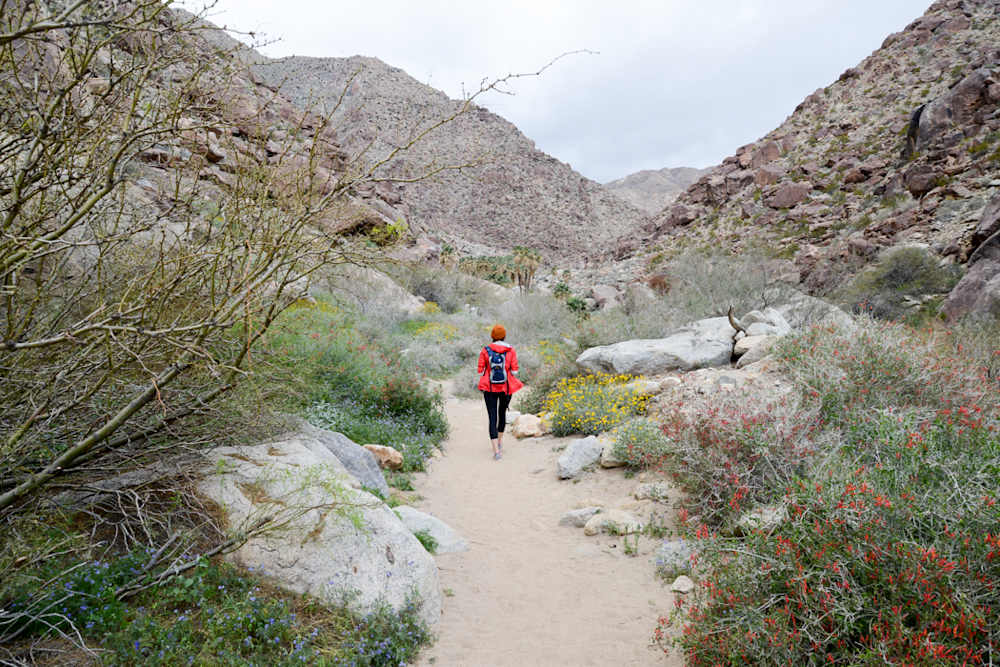
Borrego Palm Canyon Campground
Borrego Palm Canyon is a well-maintained Anza-Borrego staple with modern restrooms (rebuilt after a flash flood), easy access to trailheads, and surprisingly dark skies given its proximity to SoCal. Download your music before you arrive — there's no cell service — and take the palm oasis hike while you're there.
Visit Official Site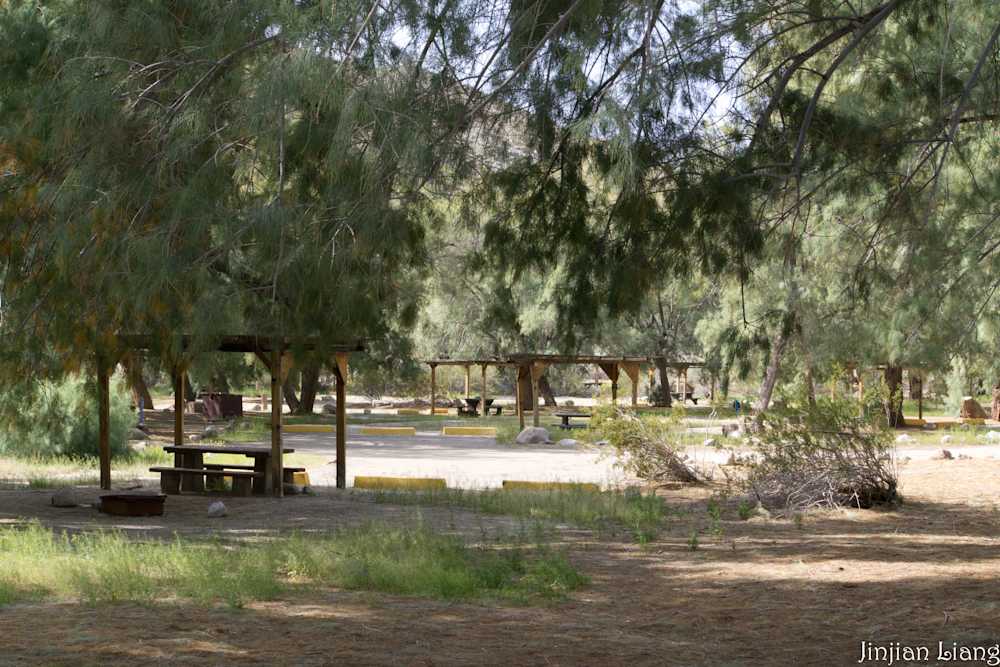
Tamarisk Grove Campground
Tamarisk Grove is a quiet desert campground with both tent sites and bare-bones sleeping cabins, flush toilets, and paid showers — just remember there's no potable water, so bring everything you'll drink. The Cactus Loop trailhead is right across the highway, and catching the cholla cacti backlit at sunset is worth the trip on its own.
Visit Official SitePlanning Your Anza-Borrego Trip
Best Time to Visit
Anza-Borrego is a winter and spring destination. Full stop. Summer temperatures routinely exceed 110°F in the low desert; dispersed camping in those conditions is not a good time, and even the higher-elevation areas above 3,000 feet reach uncomfortable heat by 10 a.m. from June through September.
October through November is the fall shoulder: temperatures drop to manageable (80s during the day, 50s at night), crowds are light, and the light quality shifts to something warmer and more golden. Good months for desert exploration without the wildflower frenzy. Tarantula migration peaks in October—the males roam across roads and trails looking for mates, which is alarming to some people and delightful to others.
December through February brings the best camping weather: highs in the 60s and 70s in the low desert, nights cold enough to require a real sleeping bag (sometimes below freezing at higher elevations). The Milky Way is spectacular on moonless winter nights—Anza-Borrego's International Dark Sky Park designation is well-earned, and December and January have the longest dark windows. This is also when wildflower anticipation builds; by January, botanists are watching the annual precipitation numbers and making predictions.
March and April are the wildflower months, when the park can go from empty to gridlocked in a matter of days if a superbloom event unfolds. The crowds during a genuine superbloom are intense—Highway S-3 into Borrego Springs has seen multi-hour backups, and spontaneous roadside parking creates real hazards. Come midweek if at all possible, arrive before sunrise, and be patient. In a non-bloom year, March and April are pleasant and quiet, with warm days and comfortable nights.
What to Know Before You Go
Free dispersed camping requires no permit. This is true and unusual for California. You can camp anywhere in the park outside of developed campgrounds and designated day-use areas, for up to 30 days, at no cost. The only rules: 200 feet from water sources, 1 mile from paved roads in most areas, and leave-no-trace principles apply (pack out all waste; gray water must be packed out or buried). The park boundary maps are downloadable from the Anza-Borrego Desert State Park website; roads suitable for dispersed camping access are marked on the detailed topo maps available at the visitor center in Borrego Springs.
High-clearance vehicles are strongly recommended for most dispersed camping roads. Some washes are accessible in a standard passenger car with careful driving; others absolutely are not. Font's Point road is the classic example of a route that swallows unprepared vehicles. If you're in a rental or a low-clearance car, Borrego Palm Canyon Campground and Tamarisk Grove Campground have developed sites with regular road access. The visitor center staff will tell you which roads are currently passable.
Water does not exist in the backcountry. None. The springs and water sources marked on older maps are unreliable. Carry 1 gallon per person per day minimum, more in warm weather. The visitor center in Borrego Springs has potable water. Borrego Palm Canyon Campground has water. Nothing else can be counted on.
The International Dark Sky Park designation is real. Light pollution from the greater San Diego metro is visible as a faint glow to the southwest, but the majority of the sky is dark. A moonless night in February or March, away from Borrego Springs, will show you the Milky Way in a way that's increasingly rare in Southern California. Red-light headlamps only after dark if you're camping with others who are stargazing.
Cell service is limited to the town of Borrego Springs. Download offline maps (Gaia GPS has excellent coverage for Anza-Borrego), download the park map PDF, and save emergency contact numbers before you leave cell range. The Borrego Springs town center has reliable service; a few miles out of town it drops to nothing.
Bighorn sheep are frequently visible around Borrego Palm Canyon and the Hellhole Canyon area. Early morning and late afternoon are peak activity windows. They're wild animals on steep terrain—do not approach, do not offer food, and keep dogs leashed at all times (dogs are not permitted on trails in the park).
Nearby Activities
Borrego Palm Canyon Trail is the park's essential hike—3 miles round-trip from the developed campground to a native California fan palm oasis fed by a natural spring. Bighorn sheep are regularly spotted on the canyon walls. The trail is easy enough for most fitness levels and spectacular in the early morning before heat builds. Arrive at the trailhead before 8 a.m. to beat both the heat and the crowds on busy weekends.
Font's Point is a 4-mile round-trip drive down a sandy wash road (high clearance strongly recommended) to an overlook above the Borrego Badlands. The panorama at sunrise is one of the more dramatic landscapes in Southern California—miles of eroded clay hills, canyon washes, and complete silence except for the wind. The road to Font's Point is off S-22 (Borrego-Salton Seaway); the turnoff is marked. Check road conditions with the visitor center after any rain.
The Galleta Meadows metal sculptures are free, permanently installed, and scattered across private property adjacent to the road throughout the Borrego Springs area. Pick up a map at the Borrego Springs Chamber of Commerce or download the sculpture location GPS points from the Anza-Borrego Foundation website. The mammoths on Borrego Springs Road and the sea serpent stretching across Montezuma Valley Road are the most photographed; the entire collection rewards a slow driving tour.
Slot Canyon hikes in the Painted Gorge and Fish Creek areas offer a completely different terrain experience—narrow sandstone canyons eroded to head-width, smooth walls worn by flash floods, some passages requiring sideways shimmy. The Slot (off Split Mountain Road) is accessible to most hikers; Painted Gorge requires a longer approach. Both demand a high-clearance vehicle for the approach road and flash flood awareness in storm season.
Hellhole Canyon is the park's underrated long hike—roughly 6 miles round-trip to a 35-foot waterfall (Maidenhair Falls) that runs seasonally, usually November through May. The canyon walls grow progressively narrower and greener as you climb, which feels surprising in a desert context. Bighorn sheep sightings are common. The trailhead is off Palm Canyon Drive west of Borrego Springs.
Stargazing is a standalone activity here. The Borrego Springs Astronomical Society hosts regular public star parties at the Community Park in Borrego Springs, typically on Saturday nights around new moon. Club members set up large telescopes and walk newcomers through the sky. Check their website for the current schedule; events are free and excellent for anyone who has never looked through a proper telescope.
Frequently Asked Questions
Is dispersed camping at Anza-Borrego really free with no permit?
Yes—this is one of the unusual things about Anza-Borrego. California state park dispersed camping typically requires a fee and sometimes a permit, but Anza-Borrego's size and management model allow free, no-permit dispersed camping throughout most of the park's backcountry for up to 30 consecutive days. The rules are straightforward: stay at least 200 feet from water sources, at least 1 mile from paved roads (check the current park map, as specific areas vary), pack out all waste, and respect fire restrictions. The developed campgrounds—Borrego Palm Canyon, Tamarisk Grove, and others—charge standard fees. But if you have a suitable vehicle and the right gear, Anza-Borrego's backcountry is among the most accessible free camping in the state.
When does the Anza-Borrego superbloom happen and how do I know if it will occur?
The superbloom isn't annual—it requires a specific combination of fall and winter rainfall, temperature patterns, and timing that only aligns every several years. The last major superbloom was 2019; notable but smaller blooms occurred in 2023. The variables are tracked closely by the Anza-Borrego Desert Natural History Association, which runs a wildflower hotline (760-767-4684) updated regularly from January through April. Even in non-superbloom years, meaningful wildflower displays occur most seasons after any measurable rain—particularly along the Henderson Canyon Road and in the open flats east of Borrego Springs. Check conditions in late February before committing to a bloom-chasing trip.
Do I need a high-clearance vehicle to camp at Anza-Borrego?
For dispersed camping, a high-clearance vehicle is strongly recommended—many backcountry roads are sand washes or rocky two-track that will strand a standard passenger car. A truck or SUV with decent clearance handles the majority of accessible dispersed sites; a lifted 4WD opens up more remote areas. If you're in a standard passenger car or rental, you have two good options: Borrego Palm Canyon Campground and Tamarisk Grove Campground both have developed sites with paved or well-graded road access, restrooms, and reasonable facilities. The visitor center in Borrego Springs can advise which wash roads are passable given current conditions—road state changes significantly after rain.
What are the metal sculptures at Anza-Borrego and where are they?
They're a collection of nearly 130 life-size and monumental steel sculptures installed on private land (Galleta Meadows) in and around Borrego Springs, created by artist Ricardo Breceda and funded by the late philanthropist Dennis Avery. The subjects range from prehistoric megafauna (Columbian mammoths, a giant ground sloth, a saber-toothed cat) to historic scenes (a Spanish conquistador, a galleon) to fantastical creatures (a 350-foot sea serpent stretching across the desert). They're visible from public roads, free to view, and permanently installed. A GPS map of all sculpture locations is available through the Anza-Borrego Foundation and the Borrego Springs Chamber of Commerce. The mammoths along Borrego Springs Road and the serpent along Montezuma Valley Road are the most iconic.
How dark is the sky at Anza-Borrego and is it worth visiting for stargazing?
Anza-Borrego holds Gold Tier International Dark Sky Park designation from the International Dark-Sky Association—one of a handful of parks in California with that status. The low desert elevation, dry air (minimal moisture to scatter light), and distance from major urban cores combine to produce exceptional skies on moonless nights. A faint glow from San Diego is visible to the southwest on clear nights, but it doesn't materially affect viewing north, east, or straight up. The Milky Way core is visible to the naked eye during winter and spring. The Borrego Springs Astronomical Society holds monthly public star parties in the park with large-aperture telescopes open to visitors; dates are posted on their website and are free to attend. December through March offers the longest dark window and the clearest air.
Are there any dangers or hazards I should know about camping at Anza-Borrego?
The main hazards are heat, water scarcity, and flash floods. Summer heat (June–September) is dangerous—triple-digit temperatures in the low desert are the norm, and heat illness can develop faster than people expect. Outside summer, daytime heat is manageable but dehydration remains a real risk; carry more water than you think you need, at minimum 1 gallon per person per day. There is no reliable surface water in the backcountry. Flash floods are a risk in canyon washes during and after rain—the sky above you can be clear while a storm 20 miles away drains into the canyon you're camped in. Never camp in a wash bottom. Rattlesnakes are present throughout the park; watch where you step and where you put your hands on rocks. Vehicle preparedness matters: a flat tire in the backcountry without a spare and basic tools, in summer, is a serious situation.
Wildlife Sounds
Observations from iNaturalist